
SILProofWorkspaceBeta

Functional safety workspace · IEC 61508 · IEC 61511

Build a defensible SIL claim. Not just a PFDavg.

Design, verify and document SIFs with confidence—
all in one workspace.

No credit card required

Sample deliverable

The report your assessor reads.

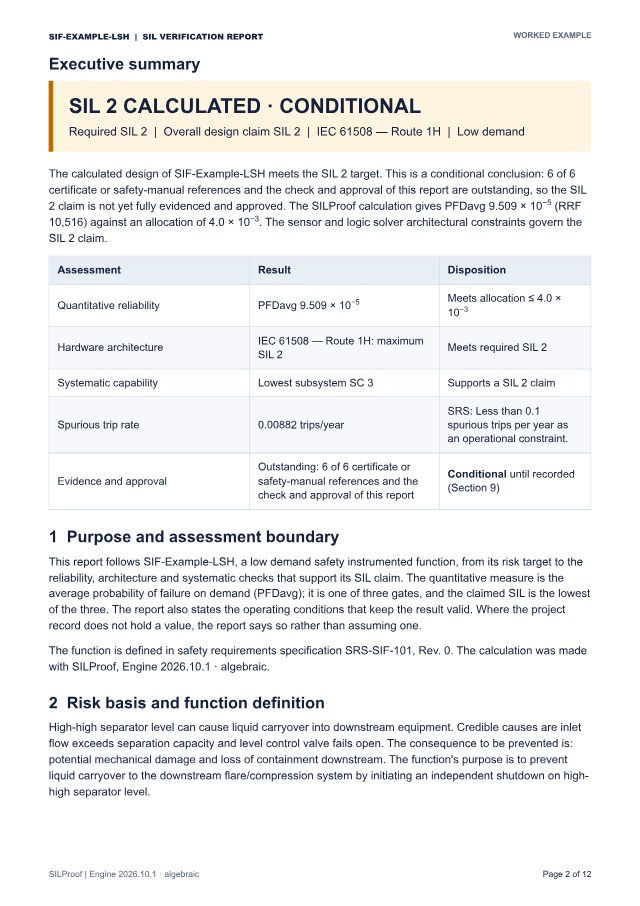
Every input, assumption and gate result, on the record. This is a real page from the worked example’s SIL Verification Report.
Download the PDF
Executive summary: SIL 2 calculated, conditional, with the three gates
Executive summary · three gates

12 pages · free account to download, Google or an email link · no password

The three-gate rule

A PFDavg in the SIL 2 band does not
make a SIL 2 function.

IEC 61508 asks three questions of every safety function. SILProof answers all three on one record, and the lowest governs, as an assessor will check.

  1. Gate 1Quantitative integrity

    PFDavg for low demand, PFH for high demand or continuous mode. β, proof-test coverage and 1oo2D voting are explicit inputs, never hidden defaults.

  2. Gate 2Architectural constraints

    HFT and SFF by Route 1H, Route 2H or IEC 61511 Table 6, chosen per subsystem.

  3. Gate 3Systematic capability

    SC 1–4 for each subsystem. The weakest element sets the loop's capability, and the record names it.

How it works

One record. Four stages.

Required SIL, requirements and verification evidence stay on the same SIF — the way you defend it to an assessor.

IEC 61511-1 safety lifecycleMgmt of FS · Cl. 5
  1. 1Hazard and risk assessmentOutside SILProof scopeCl. 8
  2. 2Allocation to protection layersSIL determination · Risk AnalysisCl. 9
  3. 3SIS safety requirements specificationSRS BuilderCl. 10
  4. 4SIS design and engineeringSIL Verification · issued reportCl. 11
  5. 5Installation, commissioning and validationOutside SILProof scopeCl. 14–15
  6. 6Operation and maintenanceOutside SILProof scopeCl. 16
  7. 7ModificationOutside SILProof scopeCl. 17
  8. 8DecommissioningOutside SILProof scopeCl. 18
Verification · Cl. 7 at every phaseOne SIF record · phases 1–4

The PFDavg and SFF/HFT calculators stay separate, so a screening number is never taken for a verified claim.

Who it is for

Built for the engineers who sign the claim.

Process industries — oil & gas, chemicals, power, pharma, water — and the consultancies and EPC teams that serve them.

Functional safety consultant / EPC

Issue SRS and verification records with a traceable basis — the same three gates your client’s assessor will check.

Functional safety / SIS engineer

Run verification with every assumption visible, then hand it to independent review without rebuilding the sheet.

Process safety engineer

Carry the required SIL and its risk basis from LOPA or Risk Graph straight into the SIF record.

I&C / instrumentation lead

Keep λ, its source, proof-test interval, route and voting with the tag — not in a side spreadsheet.

The expertise behind it

Shaped by CFSE expertise and 23 years in high-hazard industries.

The ideas and engineering approach behind SILProof come from a Certified Functional Safety Expert (CFSE). The methods follow IEC 61508 and IEC 61511, and every equation and assumption is shown, so you can check the work the way an assessor would.

CFSE
Certified Functional Safety Expert
23 years
of high-hazard industry experience
IEC 61508 · 61511
methods shown, never hidden

SILProof is independent and not endorsed by the CFSE certification body.

Next step

Try the demo SIF. Then build your own.

Change any input and watch the SIL move. Free account, no credit card.

Build a defensible SIL claim. Not just a PFDavg.

A modern, structured workspace to perform SIL verification, manage SIFs, generate SRS documentation, and maintain functional safety records. Scope: process-sector SIFs in the design phase — required SIL, SRS, three-gate verification and an issued report.

One SIF thread from risk to verification

Process safety, SIS, I&C and EPC engineers keep required SIL, architecture, verification evidence and specification on the same Safety Instrumented Function record. SILProof is built for IEC 61508 hardware and systematic capability thinking and for the design phase of an IEC 61511 process-sector SIF — without turning the browser into a certificate authority. What is in and out of scope is listed clause by clause on the scope page.

  1. Risk — Set required SIL and risk-reduction basis with Risk Analysis (Risk Graph, LOPA or company matrix).
  2. Register — Keep every project function in the SIF Register.
  3. SIF — Open the hub for identity, status, architecture summary and next steps.
  4. SRS — Capture safe state, response time, proof testing and interfaces in the SRS Builder.
  5. Verify — Design the sensor, logic solver and final elements and prove the claim in SIL Verification.

Three gates to a defensible SIL claim

Claimed SIL is the lowest of quantitative integrity (PFDavg for low demand, or PFH for high demand / continuous), architectural constraints, and systematic capability. A calculated PFDavg that sits in a SIL 2 band does not by itself make the SIF SIL 2. Architecture (Route 1H, Route 2H or IEC 61511 Table 6) and systematic capability still have to support the claim. That is the three-gate rule explained in The Three Gates to SIL.

SIL Verification supports algebraic and Markov low-demand engines, voting including diagnostic 1oo2D, beta-factor common cause, proof-test coverage and explicit final-element train topology. Screening tools stay separate on purpose: the PFD / PFH calculator is a 1oo1 low- or high-demand estimate; the SFF / HFT calculator screens architectural SIL only.

PFD / PFH calculator versus full SIL verification

Use the calculator for a fast 1oo1 PFDavg or PFH screening number. Use SIL Verification when the whole SIF must be assessed — sensor, logic solver and final elements together — with architecture and systematic capability on the same record. Keeping those paths separate avoids presenting a screening result as a finished SIL claim. Background on the average probability of failure on demand is in the PFDavg knowledge note.

Open tools and engineering references

Start with language, then open a tool: What is SIL?, Knowledge Hub notes on PFDavg, Route 1H and Route 2H / Table 6.

Worked example and who it is for

The built-in Example SIF (high-high separator level shutdown) shows a complete sensor–logic–final-element loop with transparent failure-rate, proof-test and architecture assumptions so engineers can see how the three gates interact before they create a project record.

SILProof is aimed at oil & gas, chemicals, power, pharma, water and EPC teams who need the PFDavg basis, route and proof-test interval frozen with the SIF — not re-keyed across three spreadsheets. Calculators and the worked example need no sign-up; free membership opens the workspace, issued reports, SRS issue and packs. The engine is checked against IEC 61508-6 Annex B on the validation page. Independent engineering review remains required.

SILProof is an engineering-support tool. Results require independent engineering review against the applicable edition of IEC 61508, IEC 61511, project procedures and competent judgement. SILProof is not a certificate, independent assessment or standards approval.